AI-Native Software Engineering: Moving Beyond AI-Assisted Development to Autonomous Lifecycles
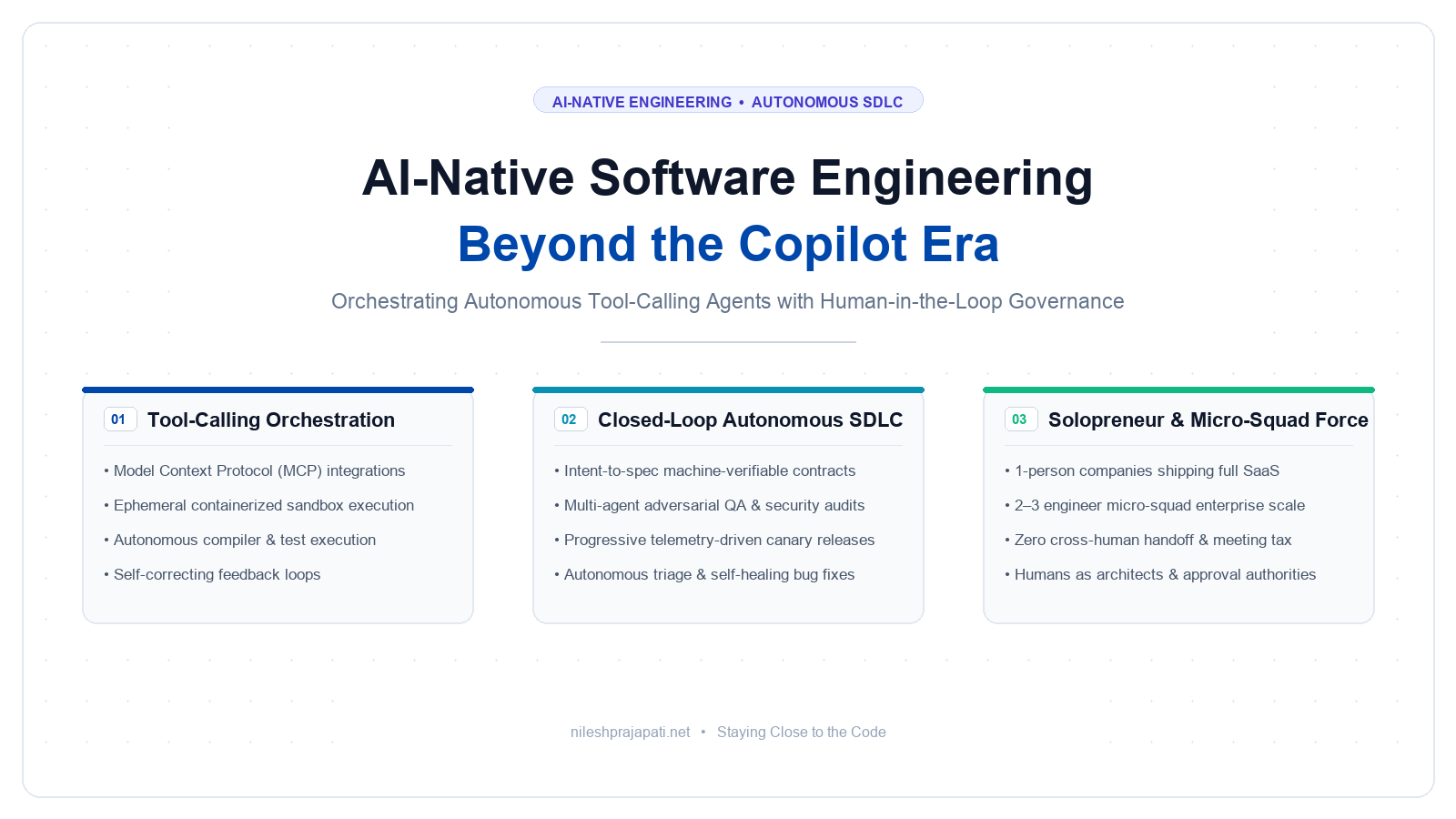
In my previous post, Software Engineering Leadership in the GenAI Era, we explored how technology leaders must transition from managing people who write syntax to architecting socio-technical guardrails and autonomous feedback loops. We identified the velocity paradox: speeding up code generation without modernizing engineering discipline merely generates technical debt at machine speed.
Over the past few months, as I have observed organizations attempting to navigate this shift, a clear pattern has emerged: most teams are still fundamentally stuck in an AI-assisted mindset.
They purchased IDE autocomplete subscriptions, installed terminal helper extensions, added conversational chatbots to their browsers, and declared their engineering organization “AI-enabled.”
Yet, their core development lifecycle remains completely unchanged. Human developers still sit in the driver’s seat typing syntax line by line. Humans still manually context-switch between five browser tabs to look up API schemas. Humans still copy-paste stack traces from terminals into chat windows. Humans still spend hours manually writing boilerplate unit tests, waiting on PR reviews, and babying deployment pipelines.
Bolting an AI autocomplete engine onto a 20-year-old, human-bottlenecked process is like strapping a jet engine to a horse carriage. It might move faster in a straight line, but the carriage was never designed for that kind of force.
We need a clean break from the past. We need to transition from AI-assisted development to AI-native software engineering.
The Fundamental Distinction: AI-Assisted vs. AI-Native
To understand the magnitude of this shift, we must define the two paradigms clearly:
- AI-Assisted Engineering: The human remains the primary execution engine. The human drives the editor, decides when to invoke the AI, reviews every autocomplete snippet in real time, manually runs the compiler, runs the tests, and manages the git branch. The AI acts merely as a passive copilot offering suggestions.
- AI-Native Engineering: The autonomous agent fleet serves as the primary execution engine across the entire Software Development Lifecycle (SDLC). The agent operates in an isolated, ephemeral sandbox environment equipped with full tool-calling capabilities (via standard protocols like the Model Context Protocol). It reads the codebase, writes the implementation, executes builds, runs tests, fixes its own errors, and stages verified artifacts.
In an AI-native world, the human developer is no longer the typist; the human is the high-leverage architect, director, and final approval authority (Human-in-the-Loop).
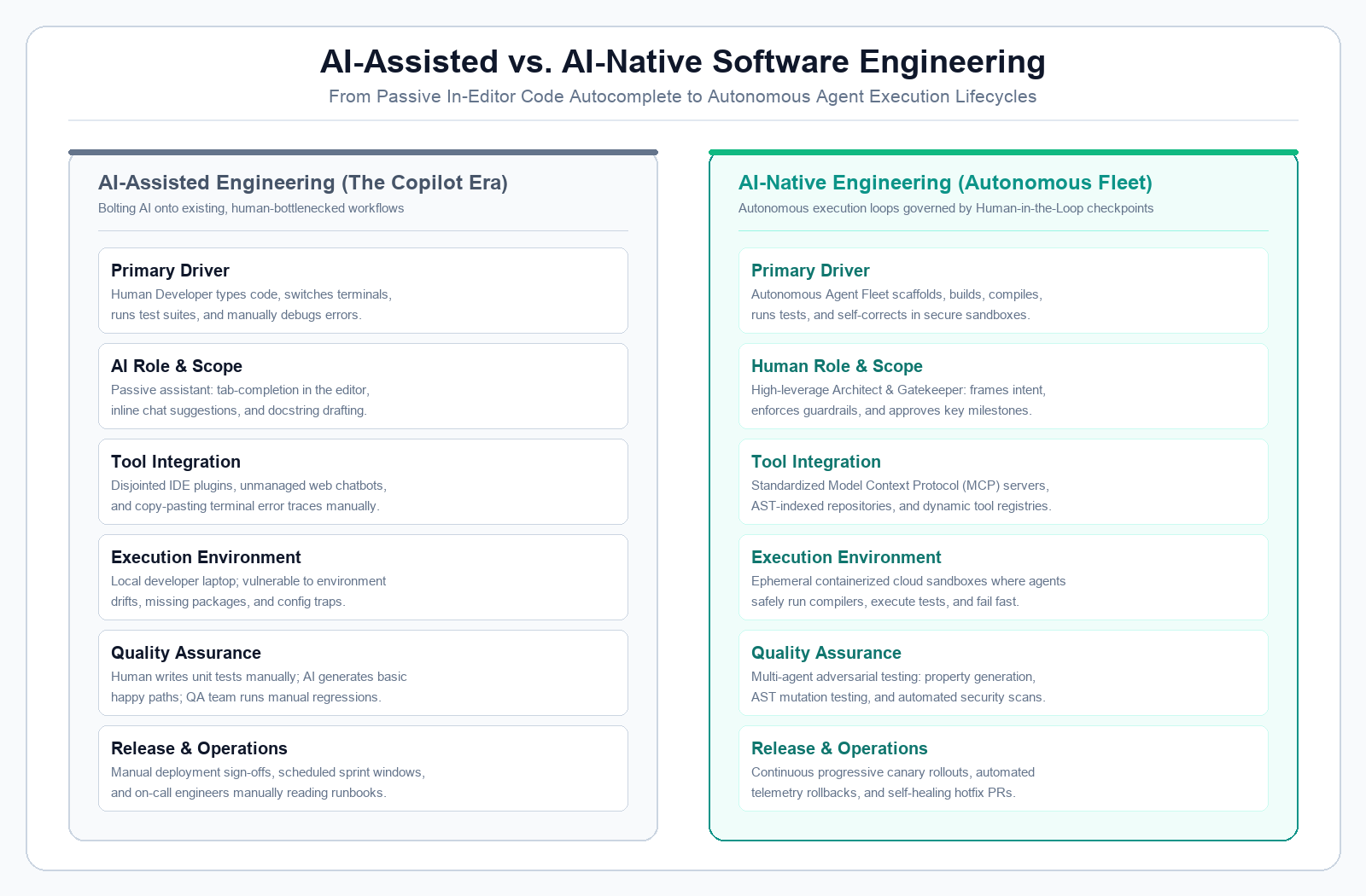
Here is how the two paradigms compare across key dimensions:
| Engineering Dimension | AI-Assisted Engineering (The Copilot Era) | AI-Native Engineering (The Autonomous Era) |
|---|---|---|
| Primary Execution Driver | Human Developer (typing in IDE, switching terminals) | Autonomous Agent Fleet (executing in cloud sandboxes) |
| Human Role | Line-by-line syntax writer and manual debugger | System Architect, Spec Author, and Strategic Gatekeeper |
| Tool Integration Model | Disjointed IDE plugins, unmanaged copy-pasting | Standardized Model Context Protocol (MCP) registries |
| Execution Environment | Local developer laptop (vulnerable to config drift) | Disposable containerized sandboxes (Firecracker / Docker) |
| Quality Assurance | Manually written happy-path tests and human QA | Autonomous adversarial QA, mutation testing & security fuzzing |
| Error Remediation | Human reads terminal trace and manually refactors | Closed-loop self-healing: Agent compiles, tests, and retries |
| Release & Progressive Delivery | Manual deployment gates and on-call runbooks | Telemetry-governed canary rollout with zero-touch rollback |
| Target Organization Model | Large functional squads (8–10 devs + QA + DevOps) | Solopreneurs & Hyper-leveraged Micro-Squads (2–3 engineers) |
The transition from AI-assisted to AI-native is not an incremental productivity boost. It represents a 10x multiplier in operational throughput.
The Catalyst: Solopreneurs and Enterprise Micro-Squads
Why is AI-native engineering suddenly the defining battleground of 2026?
Two converging forces are driving this transformation:
1. The Rise of the Solo Entrepreneur (The 1-Person Tech Company)
We are living in the era of the solo technical founder. A single engineer with deep domain insight can now build, launch, and operate an enterprise-grade SaaS platform.
However, a solopreneur cannot wear ten distinct hats simultaneously. A solo founder cannot spend Monday writing CRUD endpoints, Tuesday manually clicking through QA regression flows, Wednesday wrestling with Kubernetes deployment manifests, and Thursday triaging L1 support tickets.
For the solo entrepreneur, maximum automation is a survival imperative. An AI-native workflow allows one human to orchestrate a specialized fleet of agents; a Research Agent, a Coding Agent, a QA Synthesizer, a Security Auditor, and an SRE Watchdog.
2. The Enterprise Imperative: The 2–3 Person Micro-Squad
At the enterprise scale, organizations are abandoning monolithic development teams.
Traditional 10-person squads suffer from Brooks’ Law and coordination tax: endless standups, sprint grooming meetings, pull request bottlenecks, and communication friction. By the time eight humans agree on an implementation detail, weeks have elapsed.
Enterprises are rapidly restructuring into Micro-Squads: compact, autonomous units composed of 2 to 3 systems thinkers. But a micro-squad can only succeed if they do not inherit the manual toil of traditional teams. When paired with an AI-native execution engine, a 3-person micro-squad operates with radical velocity, delivering complex features from spec to production in days rather than quarters.
Key Technical Enablers: What Makes AI-Native Possible Now?
Until recently, true autonomous engineering was held back by model limitations and architectural silos. In 2026, four foundational breakthroughs have turned autonomous lifecycles into a production reality:
A. Model Context Protocol (MCP) and Standardized Tool Registries
Previously, connecting an AI model to an external system required custom, fragile glue code. The widespread industry adoption of the Model Context Protocol (MCP) has established an open standard for how models interact with tools, resources, and execution environments.
Instead of writing custom scripts, an agent connects to standardized MCP servers exposing:
- Codebase Navigation Tools: Semantic AST search, call-graph traversal, and type definition resolution.
- Runtime Execution Tools: Containerized terminal command execution, package managers, and compilers.
- Data Infrastructure Tools: Database schema introspectors, migration runners, and query explainers.
- Observability Tools: OpenTelemetry distributed trace queries and metric aggregators.
By standardizing on MCP, agents can reason over and manipulate external environments with deterministic precision.
B. Ephemeral Execution Sandboxes
You cannot let an autonomous agent run arbitrary code directly on a production server or a developer’s primary machine.
AI-native workflows run inside isolated, ephemeral cloud sandboxes (leveraging lightweight microVMs or container runtimes). When an agent receives a task, the platform spins up a clean, disposable environment initialized with the exact repository commit, dependencies, and local databases. The agent can compile, run unit tests, install packages, and simulate failures safely. If the agent corrupts the environment during experimentation, the sandbox is discarded with zero blast radius.
C. Closed-Loop Self-Correction & Reasoning
Modern frontier models do not just generate code; they possess strong self-correction loops.
When an agent executes code in its sandbox and encounters a compiler error or a failing test assertion, it does not stop and ask a human for help. It ingests the stdout/stderr stream, inspects the stack trace, revisits its architectural assumptions, edits the source files, and re-executes the build. The agent loops autonomously until all verification criteria pass.
D. Multi-Tier Human-in-the-Loop (HITL) Checkpoints
True automation does not mean abdication of human responsibility. An autonomous agent left entirely unchecked will eventually experience domain drift or introduce subtle security vulnerabilities.
AI-native engineering solves this through Strategic Human-in-the-Loop (HITL) Gateways. Instead of interrupting humans for every single line of code, the system defines explicit governance checkpoints where human judgment is mathematically required:
- Spec Approval: Approving typed contracts and business invariants before code is written.
- PR Intent Gate: Reviewing architectural diffs, domain fit, and security audits before merging.
- Production Remediation Gate: Confirming high-stakes production hotfixes and rollouts.
The End-to-End AI-Native Engineering Lifecycle
Here is the architectural blueprint of how an AI-native engineering process operates from inception to production feedback:
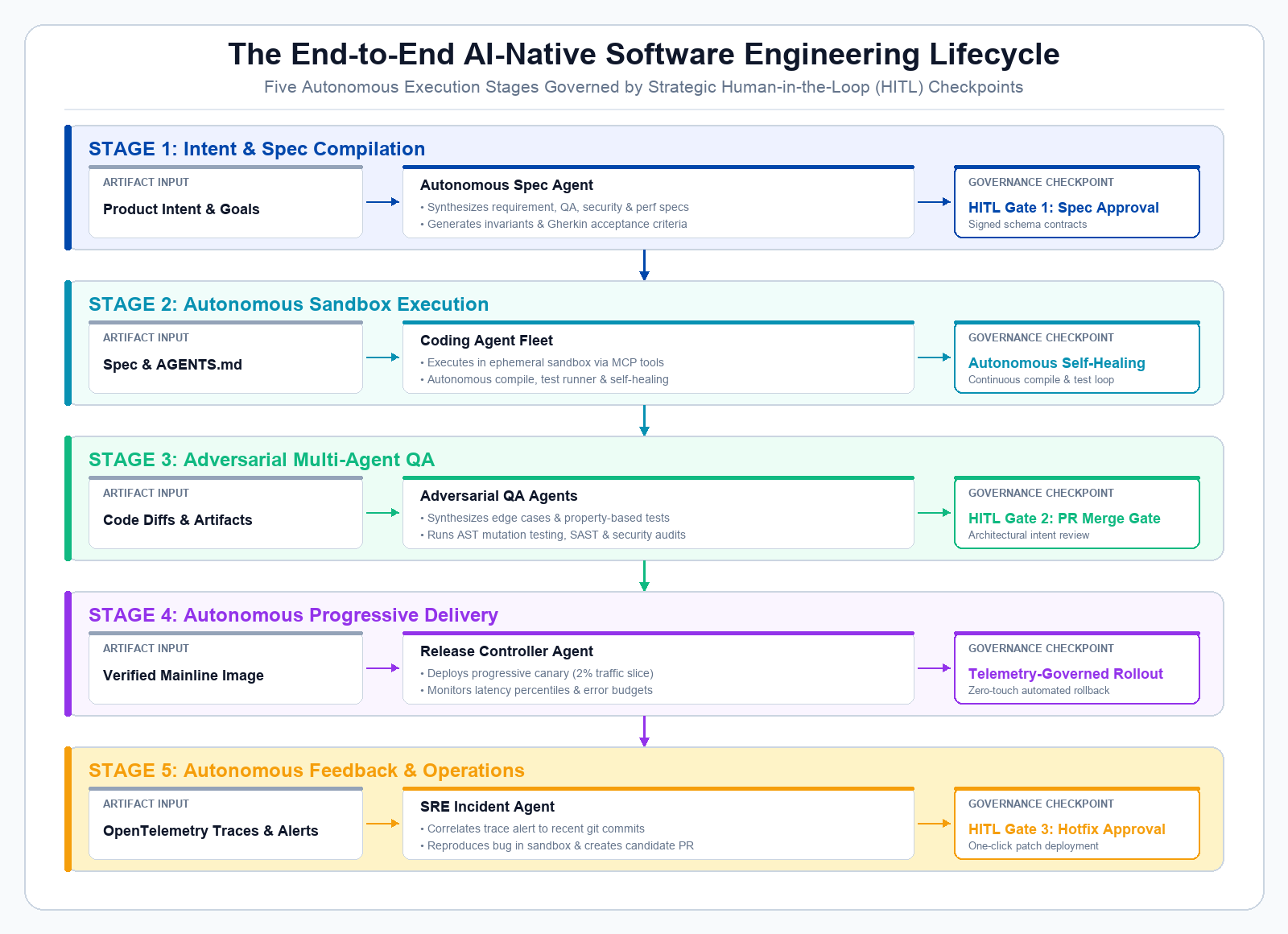
Let us walk through each of the five autonomous stages in detail:
Stage 1: Intent Ingestion & Comprehensive Spec Compilation
The process begins not with a human writing code, but with a human framing intent.
The product lead or architect provides a high-level intent document or feature brief. The Autonomous Spec Agent ingests this brief, analyzes the existing repository architecture, and synthesizes a comprehensive, multi-faceted specification artifact that serves as the single source of truth across the lifecycle:
- Requirement Specification: Decomposes the business intent into structured functional requirements, user journeys, typed interfaces, and API contracts (OpenAPI, Protocol Buffers, or JSON Schema).
- Acceptance Criteria Specification: Formulates machine-verifiable assertions, state machine transition invariants, and executable Gherkin scenarios (
Given-When-Then) for deterministic validation. - QA Test Scenarios & Test Cases Specification: Pre-compiles the entire testing strategy before code generation begins, detailing synthetic edge cases, boundary matrix scenarios, property-based test definitions, and mutation testing vectors.
- Security Specification: Establishes threat models, authentication and role-based access control (RBAC) boundaries, input sanitization rules, PII redaction protocols, and automated OWASP compliance checks.
- Performance & Operational Specification: Codifies strict non-functional constraints, including latency percentiles (P95/P99 budgets), throughput thresholds, memory/CPU quotas, error budgets, and SLA/SLO baselines.
Governance Checkpoint (HITL Gate 1): The lead architect reviews the synthesized specification. Because the specification is compact, structured, and contract-first, review takes 10 to 15 minutes rather than days of debate. Once approved, the specification is locked as the immutable execution contract.
Stage 2: Autonomous Sandbox Execution & Tool Calling
With the specification approved, the orchestrator spawns an isolated ephemeral cloud sandbox, mounts the repository alongside its living AGENTS.md rulebook, and assigns the task to the Coding Agent Fleet.
Operating through MCP tools, the agent:
- Traverses the codebase AST to locate related types, interfaces, and database models.
- Scaffolds implementation code adhering strictly to the contract.
- Invokes the project compiler/linter inside the sandbox.
- Executes the test runner.
If compilation fails or tests break, the agent enters an Autonomous Self-Healing Loop: it inspects the error trace, modifies the implementation, and retries. The human is never disturbed during this mechanical iteration.
Stage 3: Adversarial Multi-Agent QA & Security Audits
Never let the same agent that wrote the code be the sole judge of its quality.
Once the implementation passes initial checks, the orchestrator dispatches independent, specialized verification agents:
- Test Synthesizer Agent: Uses property-based testing and mutation testing (mutating AST nodes to ensure tests actually fail when logic is broken) to uncover unhandled edge cases, concurrency deadlocks, and null states.
- Security Auditor Agent: Scans diffs for OWASP Top 10 vulnerabilities, unauthorized package additions, secret leaks, and PII exposure.
Governance Checkpoint (HITL Gate 2): The agent fleet opens a pull request containing:
- An executive architectural summary.
- The verified code diff.
- The generated test suite and mutation score.
- The security audit clearance.
The human engineer reviews the PR, not to check syntax or formatting (which are already proven), but to validate business domain logic, blast radius, and system elegance.
Stage 4: Autonomous Progressive Delivery
Merging the pull request triggers continuous delivery governed by an autonomous Release Controller Agent:
- The container image is built and deployed to a 2% canary traffic slice.
- The agent monitors real-time telemetry (P99 latency percentiles, error budgets, CPU/memory profiles, and OpenTelemetry trace anomaly scores) against the baseline cluster.
- If error rates remain within strict statistical thresholds, the agent progressively promotes the deployment to 25%, 50%, and 100%.
- If an anomaly is detected, the agent triggers an immediate zero-touch rollback and notifies the squad with an incident brief.
Stage 5: Autonomous Feedback, Triage & Self-Healing Operations
In production, operational feedback loops operate autonomously:
- When an alert fires, the SRE Incident Agent correlates the alert trace with recent git commits and configuration changes.
- The agent reproduces the bug inside an isolated sandbox by synthesizing a failing integration test.
- It drafts a candidate hotfix PR addressing the root cause.
Governance Checkpoint (HITL Gate 3): The on-call engineer receives a notification with the diagnosed root cause, the reproducing test, and the proposed PR. With a single click, the engineer approves the hotfix for automated canary deployment.
Architectural Best Practices for Building AI-Native Workflows
If you are an engineering leader, solopreneur, or architect looking to implement an AI-native process today, here are four core principles to follow:
1. Treat Repository Rules as Compile-Time Guardrails (AGENTS.md & CONVENTIONS.md)
Just as README.md is written to onboard human engineers, AGENTS.md has become the standard operational manifest for autonomous coding agents.
Autonomous agents cannot read your mind; they can only follow rules and patterns they can discover in your repository. Maintain a centralized AGENTS.md file (alongside CONVENTIONS.md or a .rules directory) at the root of every repository. An effective AGENTS.md explicitly defines:
- Build, Lint & Test Commands: The exact CLI commands to install dependencies, compile code, execute unit/integration tests, and run linters in the sandbox.
- Architectural Invariants: Mandatory design patterns (e.g., domain-driven boundaries, CQRS, repository pattern) and explicitly forbidden antipatterns.
- Error-Handling Standards: Custom typed error hierarchies and boundaries instead of generic try-catches.
- Dependency & Licensing Allowlists: Approved internal packages and strict bans on unvetted third-party libraries.
- Definition of Done & Verification Criteria: The exact test coverage bars and checks that must pass before an agent is permitted to open a PR.
When an autonomous agent enters a repository, AGENTS.md is the very first artifact it ingests, anchoring its context and eliminating 90% of architectural deviations.
2. Decouple Planning from Execution
Never give an agent a vague prompt and let it start typing files immediately. Enforce a two-phase execution model:
- Phase A (Planning): The agent explores the repository, writes a dense architectural plan artifact, and lists all files it intends to touch.
- Phase B (Execution): The agent executes the plan inside a fresh context window, preventing context rot and cognitive distraction.
3. Invest in Fast, Deterministic Test Suites
Agents iterate through trial and error. If your test suite takes 35 minutes to run, an agent’s self-healing loop will stall. Optimize your test pipeline for sub-second unit execution and sub-minute integration runs. The faster an agent can get feedback from its sandbox, the faster it arrives at a correct solution.
4. Design Human-in-the-Loop as a Filter, Not a Bottleneck
Human review should only be required at high-leverage decision boundaries: spec sign-off, PR merge approval, and production write actions. If you require humans to approve every terminal command or every file read, your developers will experience notification fatigue and bypass the checks.
Concluding Thoughts: The True Leverage of the Modern Engineer
The shift from AI-assisted to AI-native software engineering is not about replacing human creativity. It is about unleashing it.
For decades, brilliant engineers have spent 80% of their working hours wrestling with boilerplate syntax, debugging missing semicolons, manually orchestrating deployments, and sitting in status update meetings. Only 20% of their energy was spent on true innovation: understanding user problems, designing elegant system architectures, and creating value.
AI-native engineering flips that equation.
Whether you are a solo entrepreneur building a company from your laptop or an engineering leader running enterprise micro-squads, maximum automation allows you to operate at unprecedented velocity with uncompromising quality.
By staying close to the code, mastering tool-calling orchestration, and embedding rigorous human-in-the-loop governance, we can build software systems that are not merely fast to write, but truly resilient, autonomous, and built to last.