Software Engineering Leadership in the GenAI Era: Architecting Teams, Tooling, and Autonomous Lifecycles
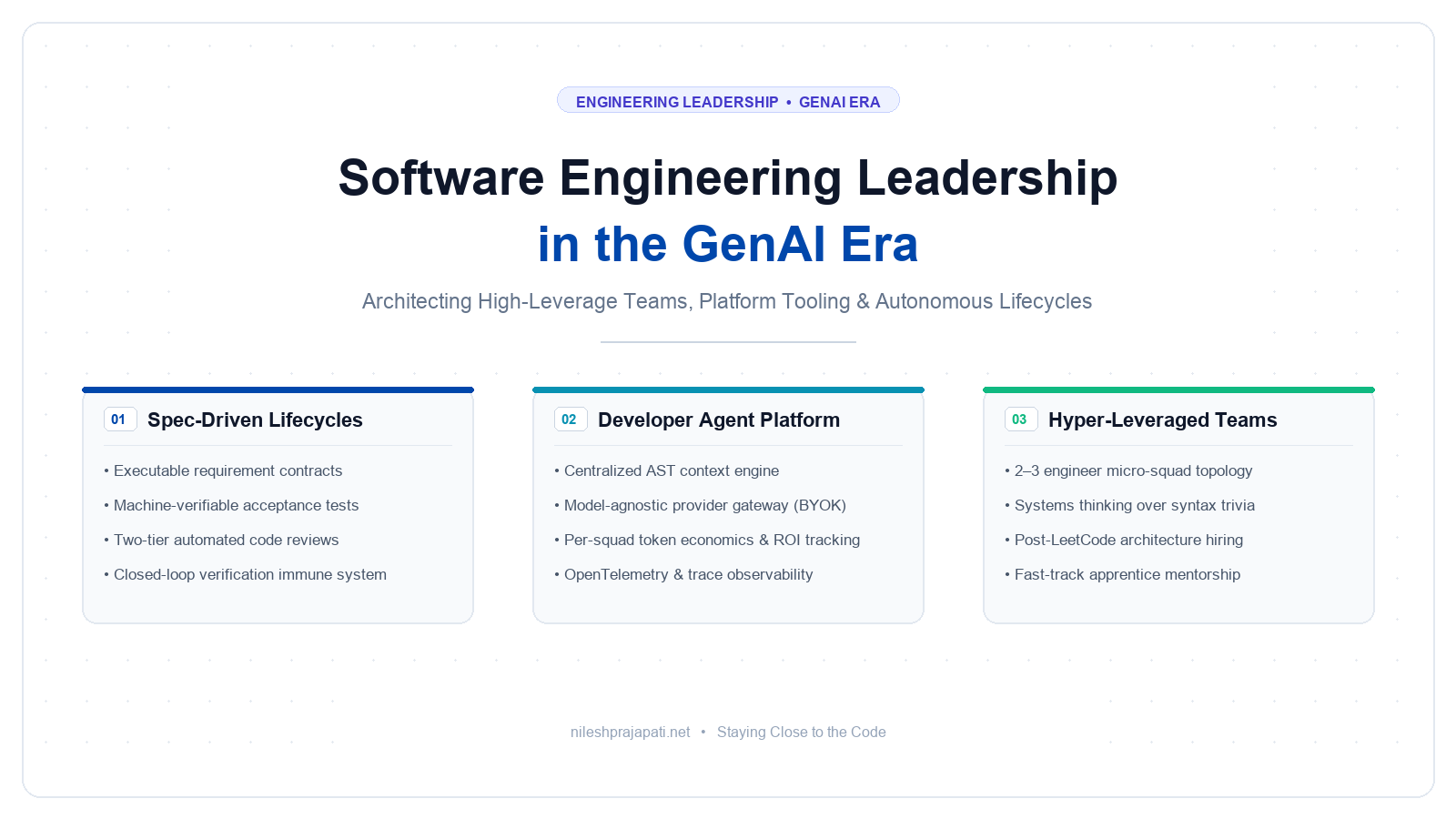
Over the past two decades, software engineering leadership has centered on predictable operational rhythms: sizing sprints, streamlining CI/CD pipelines, enforcing code reviews, optimizing team topologies, and mentoring engineers through the traditional junior-to-staff progression. We measured success through DORA metrics, velocity charts, and deployment frequencies.
The emergence of Generative AI and autonomous coding agents has upended this playbook.
Today, generating code is no longer the bottleneck. An autonomous agent can scaffold an entire microservice, generate fifty unit tests, or translate a legacy codebase in minutes. Yet, engineering organizations are finding that their net time-to-market has barely budged. Instead of faster releases, many teams are experiencing the velocity paradox: an overwhelming deluge of AI-generated pull requests, subtle architectural drift, cognitive fatigue during code reviews, and brittle deployments that fail in production.
The truth is clear: accelerating code generation without fundamentally modernizing your engineering discipline simply creates technical debt at machine speed.
For technology leaders, our primary mission is shifting. Leadership is no longer about managing people who write syntax; it is about architecting the socio-technical systems, guardrails, and autonomous feedback loops that allow human engineers and AI agents to deliver resilient software with high confidence.
As someone who has always believed that technology leadership requires staying close to the code, here is an in-depth breakdown of how engineering leaders must rethink the entire software development lifecycle from requirements and tooling to operations, hiring, and user experience.
The Paradigm Shift: From Managing Writers to Orchestrating Systems
To understand where software engineering leadership is heading, we must look at how the core leverage point of an engineer has transformed:
| Engineering Dimension | Traditional Engineering Org | GenAI-Era Engineering Org |
|---|---|---|
| Primary Engineer Activity | Writing code, implementing boilerplate, debugging syntax | Framing problems, crafting specifications, reviewing & verifying systems |
| Requirements Source | Ambiguous PRDs and narrative Jira stories | Executable specifications, schema contracts, machine-verifiable constraints |
| Tooling Footprint | Static IDEs, linters, isolated CLI scripts | Integrated agent harnesses, AST-indexed context engines, automated copilot workflows |
| Code Review Model | Peer-to-peer manual line-by-line inspection | Multi-tier review: Automated agent pre-flight checks followed by human architectural validation |
| Testing Paradigm | Manually scripted unit, integration, and E2E tests | Autonomous edge-case synthesis, property-based generation, self-healing test suites |
| Release & Deployment | Scheduled sprint releases, manual canary sign-offs | Continuous progressive delivery governed by automated telemetry analysis |
| Incident Operations | Alert fires -> on-call engineer reads runbooks -> manual triage | Agentic alert triage -> trace correlation -> proposed remediation with human approval |
| Hiring Criteria | Algorithmic puzzle-solving (LeetCode), framework trivia | Systems thinking, architectural critique, debugging instincts, domain context |
When your team’s output capacity scales exponentially, unguided autonomy leads to chaos. The leader’s job is to build a structured engineering harness around this new capability.
1. Requirement Engineering: The Era of Spec-Driven Development (SDD)
Every software defect can ultimately be traced back to an ambiguous specification. In the past, human developers compensated for vague requirements by asking questions in Slack, making intuitive assumptions, or holding impromptu design meetings.
AI agents cannot do that. When an autonomous agent encounters an ambiguous requirement, it does not stop; it hallucinates a plausible interpretation and implements it with complete confidence.
Because of this, Spec-Driven Development (SDD) has become the bedrock of modern engineering planning.
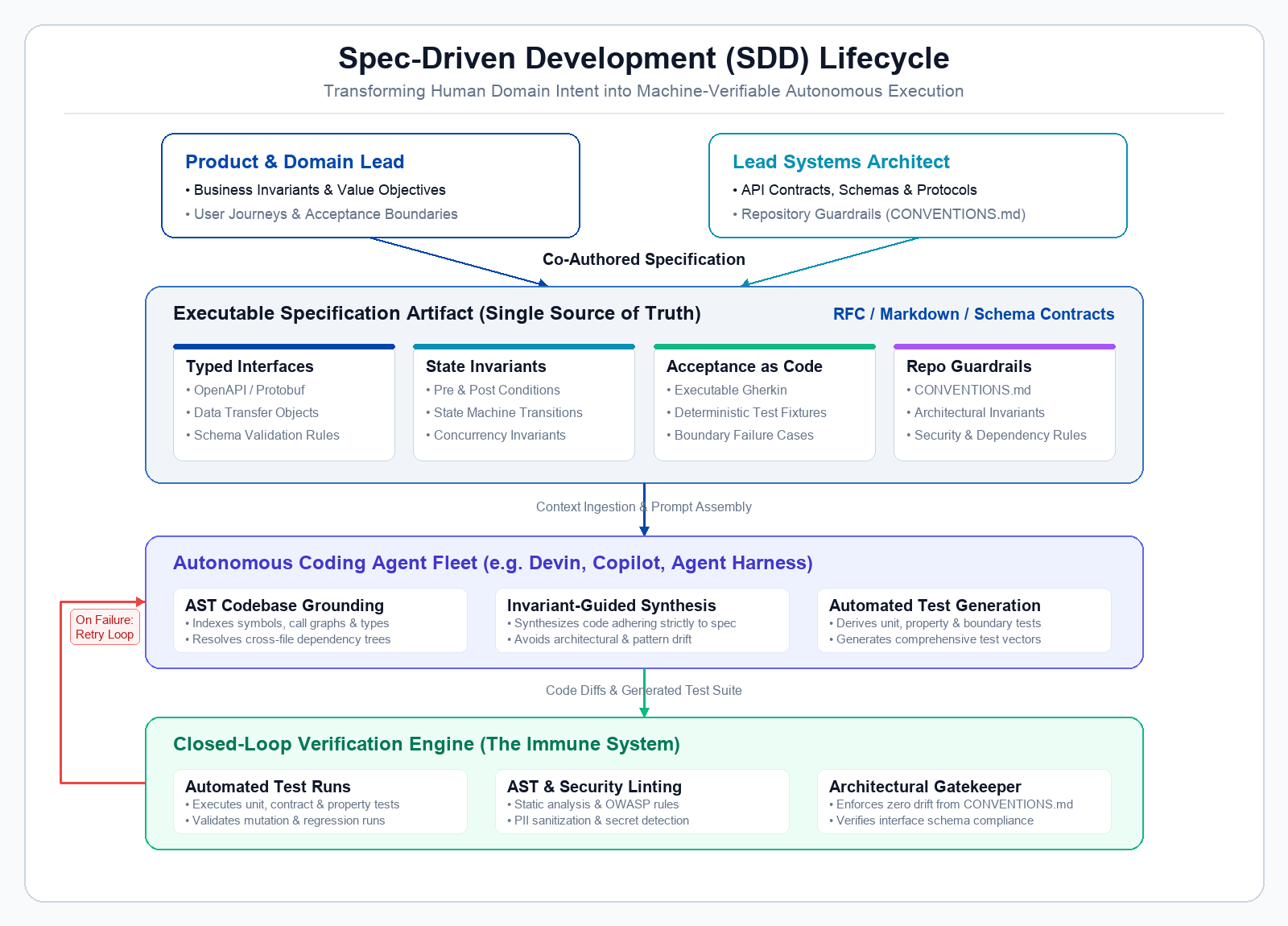
As engineering leaders, we must transition our teams away from narrative user stories toward executable, machine-verifiable specifications:
- Structured Architecture Decision Records (ADRs): Agents must ingest the repository’s architectural principles. Maintain a living
CONVENTIONS.mdor.rulesdirectory at the repository root detailing API patterns, error handling conventions, naming rules, and forbidden dependencies. - Contract-First Design: Define schemas first using OpenAPI, Protocol Buffers, or JSON Schema. When requirements are expressed as typed contracts, both human developers and agents have an unambiguous definition of success.
- Acceptance Criteria as Code: Express user requirements using structured Gherkin syntax or explicit invariant assertions (
Given-When-Then). Agents can compile these directly into executable test fixtures before generating a single line of implementation code.
When you treat specifications as compile-time artifacts rather than loose documentation, you eliminate the single largest source of hallucination in AI-assisted development.
2. Tooling Strategy: Building the Internal Developer Agent Platform
One of the biggest pitfalls I see technology leaders stumble into is tool sprawl.
Teams jump on every new AI-powered widget: three different IDE autocomplete extensions, isolated web chatbots, unvetted browser plugins, and disjointed script generators. The result is a fragmented developer experience, ballooning token licensing costs, and severe security risks where proprietary code leaks into untracked external APIs.
Engineering leaders must approach AI tooling not as individual developer perks, but through the lens of Platform Engineering.
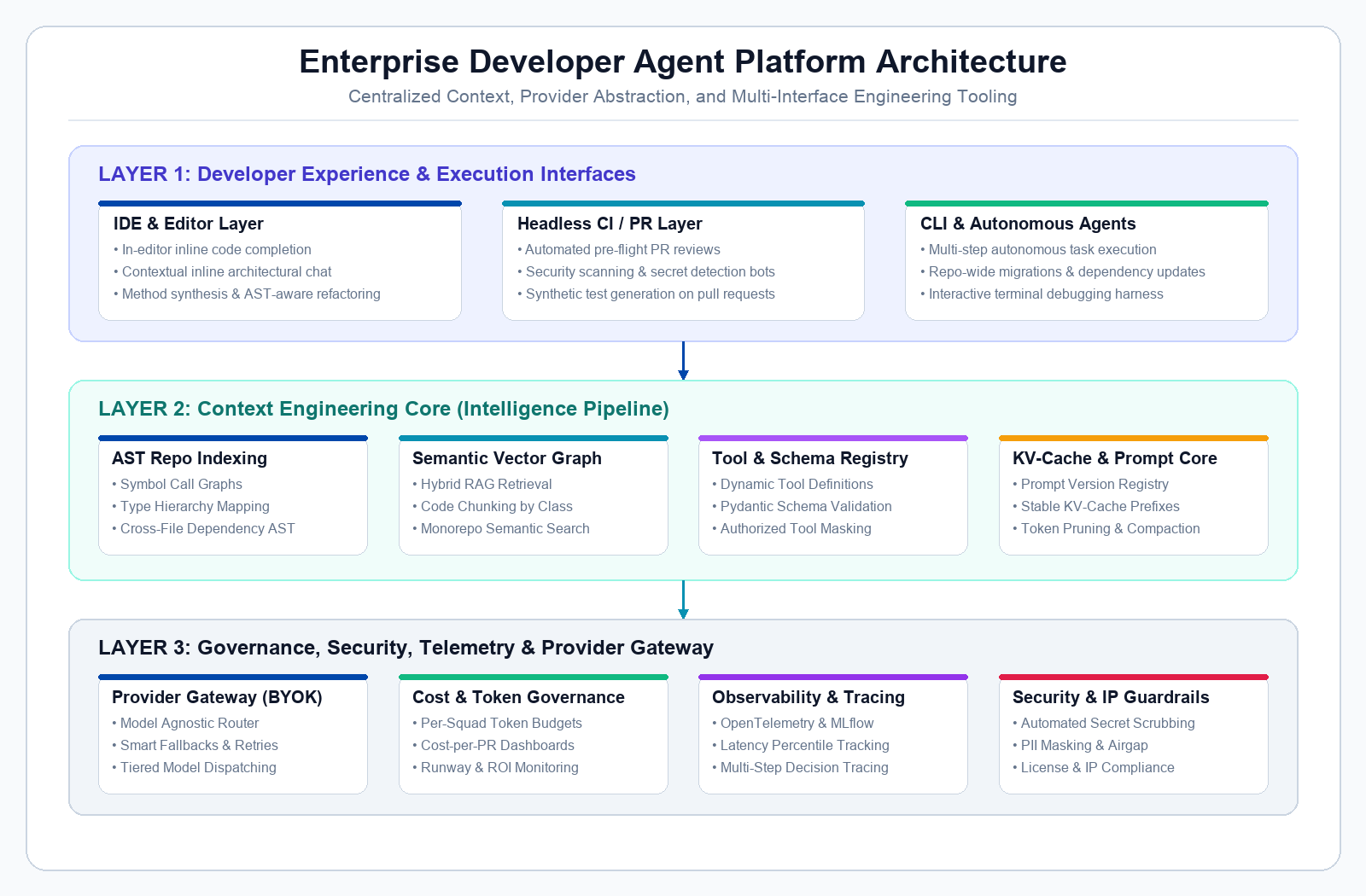
A mature Developer Agent Platform provides four foundational capabilities:
A. Centralized Context Engineering & Indexing
Generic LLMs lack codebase intuition. Your platform must index codebases using Abstract Syntax Trees (AST) combined with semantic dependency graphs. When an engineer or an agent works on a feature, the tooling should automatically select and compress only the relevant interfaces, dependency trees, and call hierarchies into the context window.
B. Provider Abstraction (Bring Your Own Key - BYOK)
Never marry your engineering workflows to a single proprietary model provider. Models evolve at breakneck speed. By wrapping your developer tooling in a model-agnostic gateway, you retain the ability to route lightweight tasks (like docstring generation or lint fixes) to smaller, high-throughput models (e.g., Llama 3 or Claude Haiku) while routing complex refactoring to deep reasoning models.
C. Cost Economics and Token Governance
AI tooling is an operational expenditure. Leaders must establish observability dashboards tracking token usage, latency percentiles, and cost-per-PR across teams. This prevents runway evaporation while identifying teams that may be struggling with repetitive, unoptimized agent loops.
D. Security & Data Sovereignty Guardrails
Enforce automated secret redaction, PII sanitization, and IP provenance checks before code leaves developer workstations.
3. Deep Process Automation: Code Reviews, QA, and Progressive Delivery
Process automation in the GenAI era is not about running shell scripts faster; it is about building closed-loop verification pipelines that act as immune systems for your codebase.
Automated, Layered Code Reviews
The traditional model of human engineers reviewing every single line of syntax in a 600-line pull request is dead. When volume increases, human reviewers experience review fatigue, leading to Rubber-Stamp Approvals where critical flaws slip past unnoticed.
We need a two-tier code review architecture:
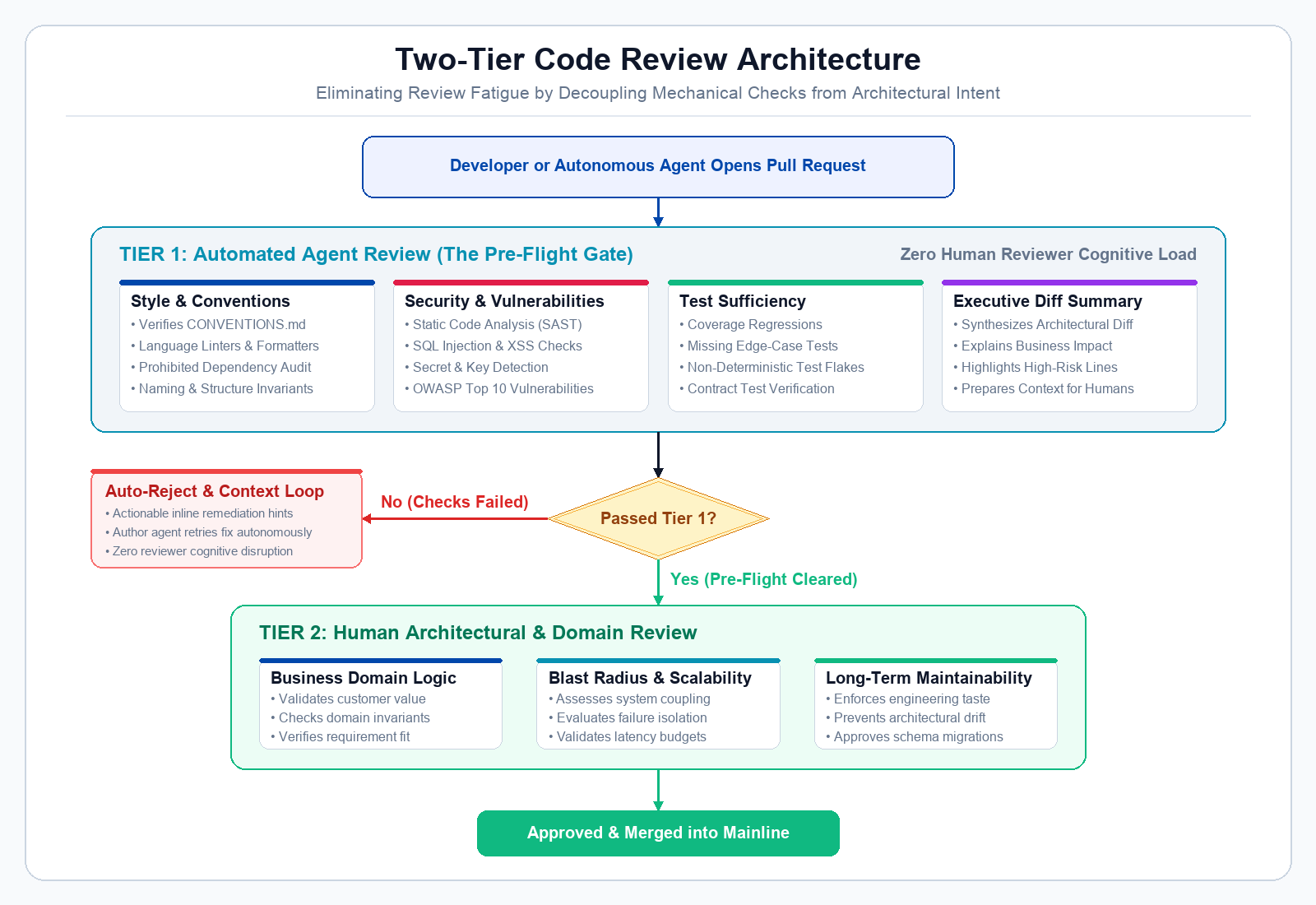
By delegating the mechanical checks to an AI agent harness, human engineers can focus their cognitive energy entirely on Tier 2: verifying intent, domain edge cases, and systemic trade-offs.
QA & Testing in a Non-Deterministic World
Testing can no longer rely purely on happy-path assertions written by the same developer who wrote the feature. Leaders should implement autonomous test synthesis:
- Adversarial Edge-Case Generation: Autonomous agents analyze incoming code diffs and synthesize boundary tests, null-pointer scenarios, race conditions, and out-of-order execution states that human engineers frequently overlook.
- Property-Based and Mutation Testing: Instead of static test vectors, employ agents that mutate AST nodes (e.g., changing comparison operators or clearing variables) to verify that the test suite actually catches breaking regressions.
- Autonomous Synthetic User Personas: In staging environments, deploy lightweight autonomous agents mimicking diverse user personas (e.g., a novice user clicking erratic navigation paths, an enterprise admin running heavy bulk exports) to uncover emergent UI and backend state bugs before real users do.
Progressive Delivery & AI-Driven Release Verification
Continuous delivery requires continuous verification. Modern release engineering must pair canary rollouts with automated observability agents:
- Canary Deployment: Deploy changes to a 2% traffic slice.
- Autonomous Telemetry Analysis: An observability agent monitors incoming metrics, comparing the canary’s P99 latency, error budgets, database query times, and log anomaly scores against the baseline cluster.
- Automated Promotion or Zero-Touch Rollback: If an anomaly score crosses a statistical threshold, the agent initiates an immediate rollback and generates an incident brief detailing the exact trace that caused the regression without waiting for an on-call engineer to wake up.
4. Operations, Support, and Feedback Loops
When software moves faster, operational feedback loops must tighten. The wall between software engineering, customer support, and site reliability operations must dissolve.
Agentic Incident Triage
When an alert triggers in the middle of the night, minutes matter. Instead of humans combing through fragmented CloudWatch or Datadog dashboards, an incident response agent should automatically:
- Correlate the alert with recent git commits, feature flag toggles, and infrastructure changes.
- Parse OpenTelemetry distributed traces to isolate the offending microservice and call stack.
- Query historical post-mortems for similar symptoms.
- Assemble a concise diagnosis in the incident Slack channel with recommended remediation commands.
L1/L2 Support Automation and Defect Remediation
Customer support tickets contain invaluable signal, but they often languish in ticketing queues.
By integrating an agent harness into customer support workflows, incoming bug reports can be automatically deduplicated, matched against existing GitHub issues, and parsed for reproduction steps. For verified defects, the agent can scaffold a minimal reproducing test case and submit a draft PR with a proposed fix, assigning it directly to the responsible squad for review.
Support transforms from a cost center into a continuous, real-time defect remediation pipeline.
5. Human Resource Optimization: Reimagining Talent, Hiring, and Team Topologies
How do you structure, hire, and scale engineering organizations when individual leverage increases by an order of magnitude?
The Death of the LeetCode Interview
For over a decade, tech hiring relied on candidates inverting binary trees or solving dynamic programming riddles on a whiteboard. Today, any standard model can solve LeetCode Hard problems in three seconds. Continuing to interview this way is not just antiquated; it selects for the exact skills that are being automated away.
Engineering leaders must redesign their technical hiring bars around four core competencies:
- Systems Architecture and Decomposition: Can the candidate break down a complex, ambiguous problem into clean domain boundaries, decoupled services, and resilient data flows?
- Code Review and Critique Instincts: Present candidates with a complex pull request written by an AI agent that contains subtle concurrency bugs, security antipatterns, or architectural flaws. Evaluate whether they can spot the traps and explain the root cause.
- Context Engineering and Problem Framing: Can the candidate effectively instruct and guide an agent to solve a real-world debugging problem? How do they handle incomplete context and failure modes?
- Engineering Judgment and “Taste”: In an era where generating code is cheap, knowing what not to build, identifying unnecessary complexity, and fighting architectural bloat is the rarest and most valuable skill.
Team Topologies: The Rise of the Hyper-Leveraged Micro-Squad
The days of sprawling ten-person development squads bogged down by endless standups, sprint estimation meetings, and handoffs are numbered.
We are seeing the emergence of Micro-Squads: compact, high-velocity teams composed of 2 to 3 cross-functional engineers (e.g., a domain lead and two full-stack architects) paired with a fleet of autonomous agents.
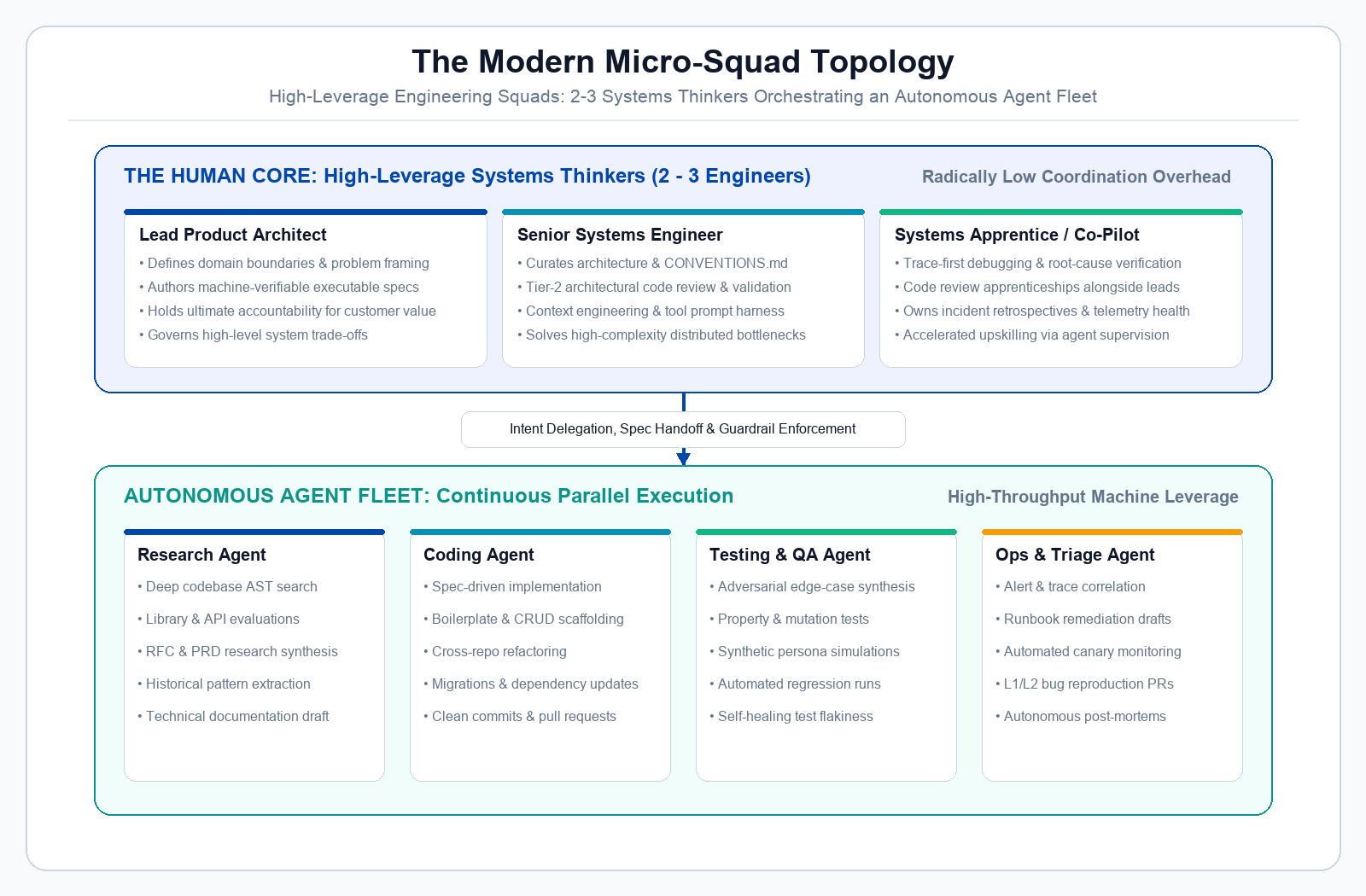
These squads operate with radical speed because communication overhead is minimized. Instead of coordinating across eight humans, two engineers coordinate shared architecture while delegating exploratory spikes, test generation, and boilerplate implementation to their agent fleet.
Solving the “Junior Engineer Dilemma”
A common anxiety among leaders is: If AI does all the junior-level coding, how will junior engineers ever learn?
If we leave junior developers to copy-paste AI suggestions blindly, we will create a generation of developers who cannot debug systems when those systems fail. Leaders must actively restructure mentorship:
- Apprenticeship in Code Review: Have junior engineers spend substantial time reviewing agent-generated code alongside senior staff, analyzing why certain patterns were accepted or rejected.
- Trace-First Debugging: Train juniors to read distributed traces, memory profiles, and logs rather than relying on trial-and-error edits.
- Owning Operational Health: Assign junior engineers to lead incident retrospectives and post-mortems. Understanding how software breaks in production builds deep engineering intuition far faster than writing CRUD endpoints ever did.
6. The User Experience (UX) Dimension in the GenAI Era
Software engineering leaders often leave UX to product designers. But in the GenAI era, user experience and system architecture are inextricably linked.
When building AI-powered applications, the UX changes from deterministic point-and-click interfaces to intent-driven, probabilistic interactions:
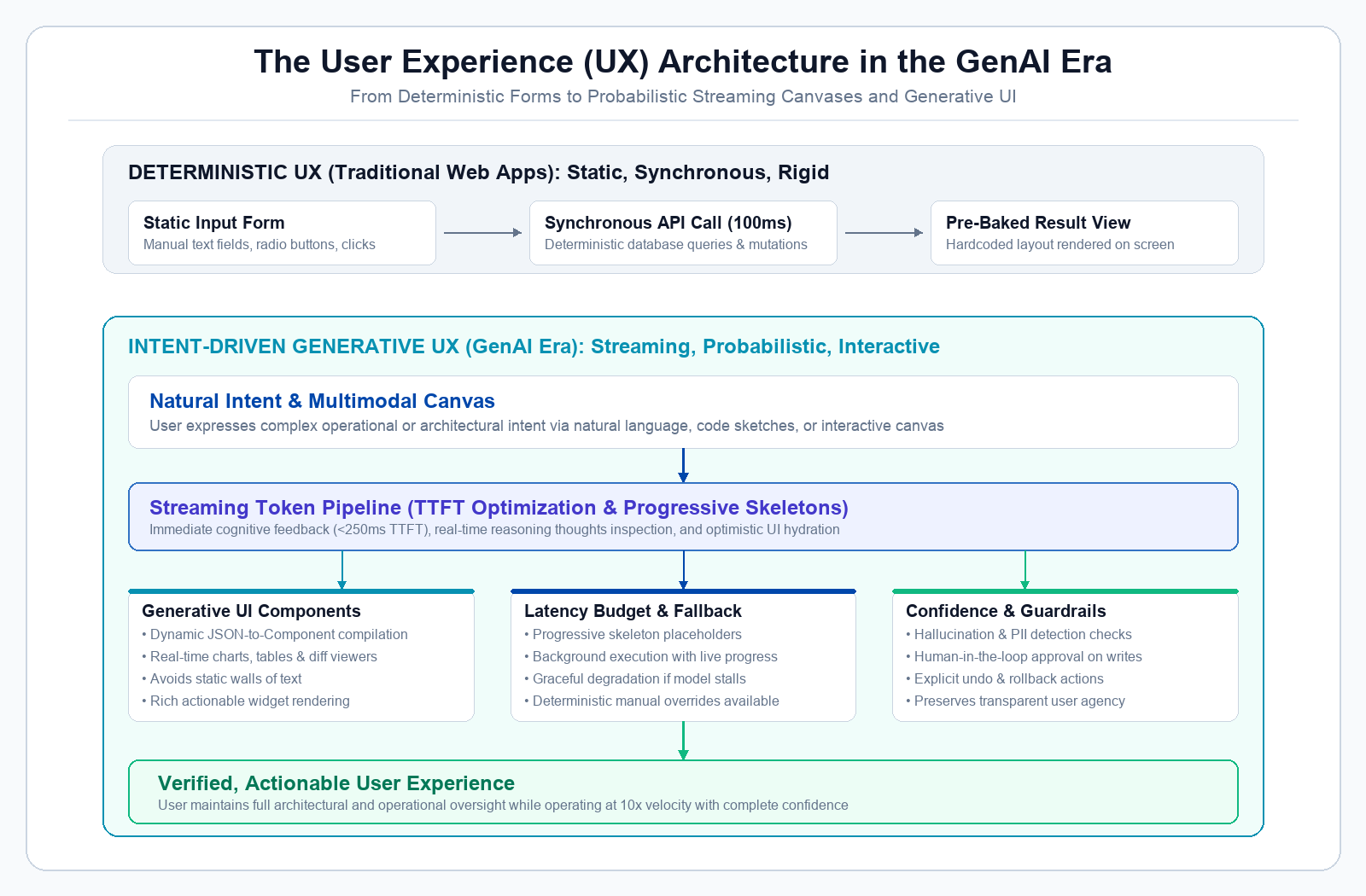
Leaders must guide their teams through the architectural realities of modern UX:
- Latency Budgeting and Streaming UI: An LLM call that takes 4 seconds to return a JSON blob will kill user retention. Architect systems for token streaming and optimistic UI updates. Render intermediate thinking steps, progressive skeletons, and partial responses to keep cognitive feedback loops instant.
- Generative UI over Plain Text Walls: Users do not want to read an essay from a chatbot when an interactive chart, a table, or an editable form would solve their problem. Architect frontend harnesses capable of rendering dynamically synthesized UI components based on structured JSON tool outputs.
- Designing for Non-Determinism and Graceful Degradation: What does your UI do when the model produces a low-confidence response, hallucinates, or times out? Build graceful fallbacks: allow users to inspect the reasoning chain, provide single-click undo mechanisms, and ensure deterministic manual controls are always accessible.
- Preserving User Agency and Trust: The goal of automation is not to make the user passive. The best UX pairs autonomous suggestions with explicit user confirmation for high-stakes actions, maintaining transparency and trust.
The Leadership Blueprint: Traditional vs. GenAI-Era Engineering
To synthesize these responsibilities, here is the operational matrix that technology leaders should use to benchmark their organization:
| Pillar | Focus Area | Key Metric to Track | Primary Antipattern to Avoid |
|---|---|---|---|
| Requirements | Spec-Driven Development (SDD) | Specification clarity score; revision iterations before implementation | Writing vague Jira tickets and letting agents guess the architecture |
| Tooling | Internal Developer Agent Platform | Developer adoption rate; token ROI; median prompt latency | Uncontrolled tool sprawl and ungoverned API keys leaking IP |
| Code Quality | Two-Tier Review Architecture | Tier-1 automated review pass rate; review cycle time | Human engineers wasting hours reviewing mechanical syntax |
| Testing | Autonomous Test Synthesis | Mutation test score; regression escape rate | Relying solely on happy-path tests generated by the authoring agent |
| Deployment | Progressive Canary Verification | Mean Time to Detect (MTTD); automated rollback rate | Manual staging sign-offs and blind 100% traffic rollouts |
| Operations | Agentic Incident Triage | Mean Time to Resolution (MTTR); incident trace correlation rate | On-call engineers drowning in unparsed telemetry alerts |
| People | Micro-Squads & Systems Hiring | Feature delivery throughput per squad; junior retention & growth | Assessing LeetCode trivia instead of systems architecture and critique |
| UX | Streaming, Generative UI | Time to First Token (TTFT); user intent completion rate | Dumping walls of unformatted LLM text onto users |
Concluding Thoughts: Staying Close to the Code
The transition into the GenAI era is often portrayed as an existential threat to software engineering. Pundits claim that software engineers will soon be obsolete.
I see the opposite. Software engineering is becoming more intellectually rigorous, more creative, and more impactful than it has ever been. We are shedding the repetitive, mechanical toil of boilerplate coding and syntax memorization. In return, we are stepping into our true calling: systems architects, domain modelers, and guardians of resilience.
For technology leaders, this transition demands more than strategic rhetoric from ivory towers. You cannot govern an autonomous deployment pipeline you do not understand. You cannot design an effective agent harness if you have never inspected an execution trace or wrestled with context rot.
The best technology leaders will always be those who stay close to the code. By mastering the tools ourselves, we can build the platforms, guardrails, and cultures that empower our engineers to thrive in this extraordinary new era.